Full read · 3 min
In this article
The lower monthly payment is only half the decision. Here is how we work through the final amount, resale value and next trade with clients.
First, what is a balloon?
A balloon, sometimes called a residual, is a fixed amount due at the end of a loan term. It lowers the regular repayments because you are paying down less of the principal during the term. It is not a discount on the machine or a portion the lender does not have to fund.
Say you borrow $300,000 for a machine with no deposit and choose a 20% balloon. The lender still funds the full $300,000 purchase. You make the agreed monthly repayments over three, four or five years, and $60,000 remains due at the end. A $100,000 balloon on the same loan is also possible if the lender agrees; that is a dollar amount, roughly 33% of the original borrowing. The permitted amount depends on the lender, term, asset and proposed use.
You also continue to pay interest on money that stays outstanding. A bigger balloon can lower the regular payment, but usually increases the total interest over the original term. Compare the total amount payable as well as the monthly figure.
Start with the exit, then choose the percentage
The question we ask is: what do you think this machine will be worth at the end of the agreed term, after the hours you expect to put on it? We are more comfortable using a balloon on equipment with a strong, reasonably predictable second-hand market, and keeping the balloon below a conservative view of its future value.
That estimate needs to allow for hours, condition, maintenance, attachments, demand for that model and the cost of selling or trading it. None of us can guarantee a resale value in five years. If the equipment may be hard to sell, become obsolete, or work harder than expected, a smaller balloon or no balloon may leave more room to move.
You do not have to take the maximum offered. A 10%, 15%, 20% or 25% balloon, or an agreed dollar amount, may be more comfortable than 30%. We work backwards from the likely exit rather than starting with the lowest repayment a quote can produce.
What does it actually save each month?
The percentage left at the end is not the percentage you save on every payment. The loan still starts at the same amount, and interest continues to run on the unpaid balance. A 30% balloon does not automatically cut the monthly payment by 30%.
Take an illustrative $200,000 loan over five years at 8% a year, with monthly repayments and no fees. With no balloon, the payment is about $4,055 a month. With a $60,000 balloon, or 30% of the original loan, it is about $3,239 a month. That is a saving of about $816 a month, or $188 a week, while leaving $60,000 due at the end. The total paid over the five years is about $243,317 without a balloon and $254,322 with one. Actual lender quotes, fees and interest calculations will vary.
If another $188 a week is manageable and you expect to keep the machine, paying it down fully may suit you better. Across a large fleet, that monthly difference can add up, so the cash-flow benefit can be meaningful. The point is to measure it against the equity and flexibility you are giving up.
One loan, two repayment options
$200,000 borrowed · five years · illustrative 8% annual interest · monthly repayments · no fees
| Structure | Monthly | Due at end | Total paid |
|---|---|---|---|
| No balloon | ~$4,055 | $0 | ~$243,317 |
| 30% balloon | ~$3,239 | $60,000 | ~$254,322 |
About $816 less each month, with $60,000 to settle at the end. These are mathematical illustrations, not lending quotes.
What if you want to trade before the term ends?
A balloon is not only an end-of-term question. Suppose the $200,000 example above has 38 monthly payments left. At about $3,239 a month, those scheduled payments add to roughly $123,000, and the $60,000 balloon makes about $183,000 of scheduled payments still to come. That sum includes future interest. It is not the amount you would necessarily owe to settle the loan today.
In that simplified example, the underlying loan balance after 22 payments is roughly $155,000 before any lender adjustment or fee. An actual early payout is determined by the lender and may include or account for interest adjustments, break costs and fees. Ask for a dated payout quote before agreeing to a trade or sale.
If the machine could sell for only $150,000 at that point, there may be little or no equity to take into its replacement and potentially a shortfall to cover. Without a balloon you generally pay principal down faster. We are cautious about putting large balloons on every asset in a fleet, because the owner may need the freedom to move an underperforming machine on before the scheduled end date.
When a larger balloon may make sense
Some high-utilisation fleets deliberately turn machines over around the end of a three-year warranty. For an eligible asset, a lender may allow a three-year term with a balloon as high as 50%. The operator gets a lower regular payment and plans to trade the machine for new equipment at that point.
That can be a sensible strategy where the hours, resale demand, trade cycle and replacement program are understood. It is also a bigger bet on the exit value. The machine has to be worth enough to clear the final amount and ideally leave equity for the next purchase. Lender limits vary, and a short term or manufacturer warranty is no guarantee of the sale price.
Four ways to handle the amount due
At maturity, you can pay the balloon from cash flow and keep the machine; sell it privately and clear the finance; trade it and apply the proceeds to the balloon before buying the replacement; or ask to refinance the remaining amount over a new term.
A refinance is a fresh credit decision, not an automatic extension. The rate, term, repayments, asset age and lender appetite at that future point could all be different. A one-, two- or three-year follow-on term may produce a manageable payment, but we would rather price the options than promise it will match the original monthly amount.
How we decide with a client
We put the zero-balloon and balloon quotes side by side: monthly repayment, final amount, total paid, likely time in the fleet, conservative resale value and what a trade halfway through might look like. We ask which assets are likely to hold value and which are more exposed to hours, obsolescence or uncertain demand.
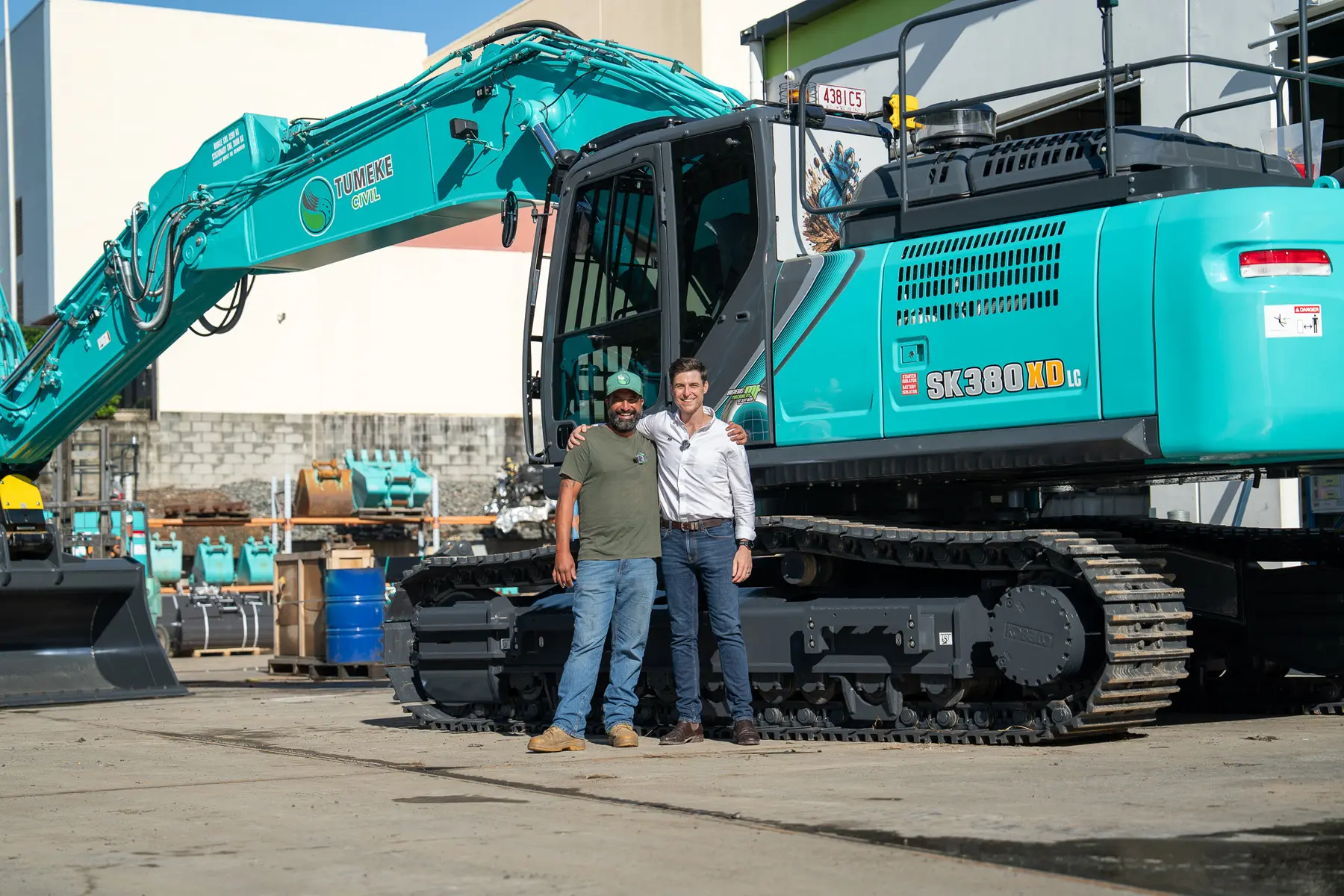
Tumeke Civil shows this decision in practice. Several older excavator loans had balloons. The monthly payments had suited the business, but as the machines accumulated hours and became more expensive to maintain, the owners needed to know whether their likely trade values would cover the finance payouts. We mapped the existing debt and trade position machine by machine before arranging six new Kobelcos.
Working with Tumeke and Marco at Brisvegas Machinery, we compared the new monthly commitments with and without balloons. The owners were comfortable paying more each month and chose to fund most of the replacement excavators without balloons. The old machines were traded progressively; the proceeds cleared their loans, and available equity reduced new borrowing. The new structure is intended to build equity more steadily and give Tumeke greater freedom to trade again when the next machines have done their work.
A balloon is a tool. Use it when the lower repayments do something useful for the business and you have a credible way to deal with the remaining debt. If the saving is modest and a clean exit matters more, leave it out.
Every business, asset and lender is different. Talk through your circumstances with your advisers before making a finance decision.